

AI Visibility Tracking – Monitoring Generative Engine Results
See what LLMs say about your brand – Use webLyzard’s new AI Visibility Tracking feature to identify inaccurate or misleading answers of generative engines such as ChatGPT, Perplexity and other GenAI platforms before they spread.
Generative engines are becoming a primary entry point to information. Instead of browsing long result lists, users receive a synthesized answer, often with just a few brand examples and recommendations. AI Visibility Tracking ensures that your organization understands and manages how these engines describe your brand, competitors and market segments. Our Visual Analytics Dashboard helps monitor, analyze and visualize this new layer of AI-generated content. In doing so, it provides the data foundation for Generative Engine Optimization (GEO), the systematic optimization of your visibility and positioning in AI-generated answers.
From SEO to GEO – Why AI Visibility Tracking Matters
Classic Search Engine Optimization (SEO) focuses on the organic ranking of web pages to feature prominently in web search results. Generative engines change this paradigm: they compose narratives, compare options and often make explicit recommendations. Being merely “present” is no longer sufficient. Brands must appear as trusted, relevant and up-to-date within these narratives.
- AI as a new gateway to information. Generative engines mediate a growing share of product discovery, research and customer support, replacing traditional search results.
- Fewer brands per answer. LLMs replying to a question in a few paragraphs often mention only a handful of brands. AI visibility becomes a scarce resource.
- Implicit endorsements. The way a model phrases advice, highlights risk or prioritizes features shapes perceptions far beyond a single query.
- Dynamic, rapidly changing views. Model updates, new content and prompt patterns can change answers over time. This requires systematic monitoring rather than ad-hoc testing.
| AI Visibility Tracking, also referred to as LLM Listening or GenAI Monitoring, makes these mechanisms transparent. It helps you understand which brands appear for specific use cases, what arguments justify recommendations, and how these arguments evolve over time. |
Generative Engine Optimization is a New Pillar of Brand Management
GEO builds on traditional SEO, but targets answer engines instead of result lists. It focuses on the content that LLMs generate when users ask brand, product or category-level questions. GEO therefore requires continuous monitoring of AI responses across multiple GenAI engines and prompt types.
This helps create brand-safe narratives that align with your positioning while avoiding outdated or misleading information. Evidence-based optimization of owned and earned content using these narratives shapes how LLMs talk about your brand. webLyzard provides the required evidence by logging thousands of AI responses per day. We extract entities and associations and make them accessible through the webLyzard dashboard as an additional, AI-native content channel.
Brand Visibility Tracking
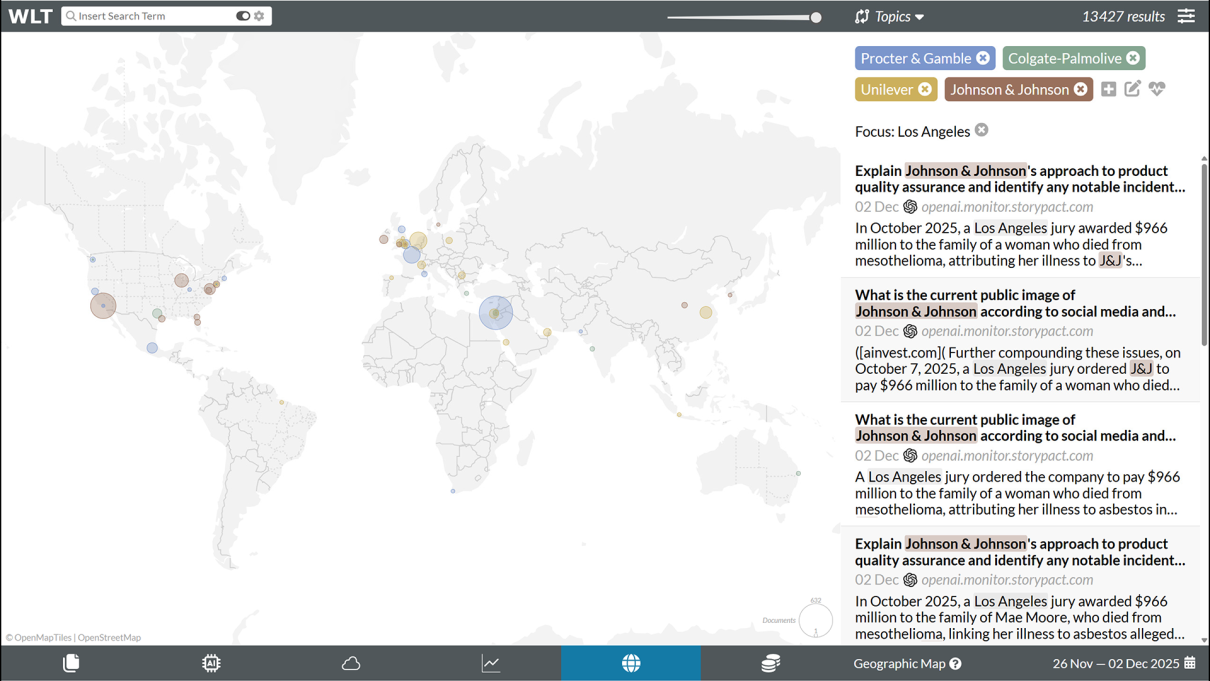
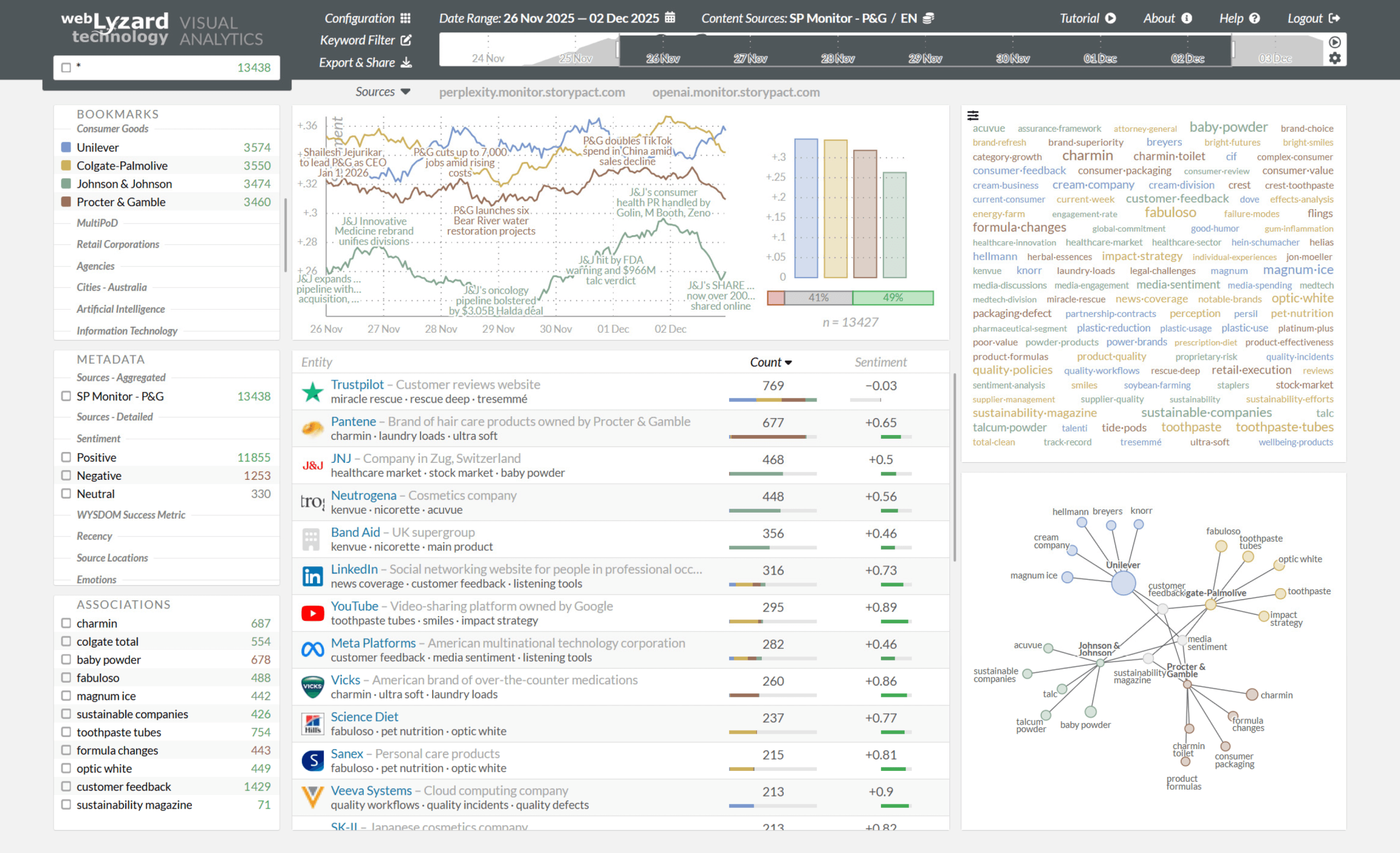
To showcase the capabilities of AI Visibility Tracking, we compared AI responses related to global consumer goods companies. The system issued high-frequency prompts to multiple generative engines, collecting brand-specific answers around the clock. This setup demonstrates that GEO analysis can achieve high temporal granularity for dynamic brand environments. With the webLyzard dashboard, users can then explore trends and patterns in AI responses through dedicated views that go far beyond simple statistics:
- Document View. One column per brand to scan AI-generated answers and compare the coverage, from product benefits to sustainability claims.
- AI Summary. An aggregated narrative across all collected responses, distilling the main talking points that generative engines associate with each brand.
- Co-occurrence Analysis. Analysis of which other brands or institutions co-occur with a company, including review sites and distribution partners.
- Tag Cloud. Interactive tool to highlight recurring concepts such as “formula changes” or “sensitivity”. It supports drill-down to the underlying AI answers.
- Geographic Map. A location-aware view that shows cities and countries appearing in GenAI outputs. This reveals where brands hold positions as innovators or market leaders.
- Word Tree. A visual exploration of the phrases that surround brand mentions, making it easy to inspect tone, qualifiers and recurrent claims.


Generative Engine Tracking does not solely rely on brand prompts. In a second example, we analyzed several thousand AI responses to generic prompts about car features, without naming any manufacturer. The results reveal which brands appear when AI engines report on reliability, safety or energy efficiency. Questions such as “What makes a dependable family car?” or “Which features are critical for electric vehicles?” generate rich, brand-agnostic answers.
The results highlight how generative engines describe the category as a whole; e.g., which benefits they emphasize, which risks they highlight and which regulations they mention. Using the collected corpus, communication teams can query for individual brands within these AI answers and benchmark their AI visibility against competitors. This enables a holistic approach to AI Visibility Tracking that captures both direct brand mentions and implicit positioning in broader industry narratives.
How Generative Engine Tracking Works
The webLyzard platform automatically sends configurable prompts to multiple generative engines. For example, it can ask brand-specific questions, perform comparative evaluations or use open category prompts such as “what are the most important features when choosing a family car?”. The system collects the resulting answers, enriches them with semantic annotations and feeds them into our knowledge graph and analytics workflows.
- Multi-Engine Coverage. Parallel queries to engines such as ChatGPT and Perplexity, with the option to add further platforms.
- High Temporal Resolution. In a typical brand scenario, the system analyzes up to 2,500 AI answers per day, enabling hour-by-hour monitoring of changes.
- Semantic Enrichment. Entity recognition for brands, products and locations; extraction of sentiment and fine-grained human emotions; clustering into topics and stories.
- Full Dashboard Integration. All AI responses become searchable, filterable and ready to be explored with the visual tools of the dashboard.
Visual Analytics Beyond Counts and Clicks
Many early GEO tools focus on coarse statistics: how often an engine mentions a brand, which sources it cites or which links appear at the bottom of an answer. While useful as a first step, these metrics ignore the content and context of the AI-generated text. The webLyzard dashboard offers a fundamentally richer approach.
- Content Analysis. Instead of counting mentions, the platform analyzes the full text of AI outputs. This helps evaluate associations, sentiment, emotions and narratives over time.
- Multidimensional Views. Coordinated visual tools (trend charts, tag clouds, geomaps, etc.) show AI visibility by topic, region, channel and time range.
- Explainable Metrics. Every aggregate score can be traced back to the underlying AI answers, enabling audits for sensitive domains.
- Cross-Channel Integration. webLyzard analyzes AI-generated content alongside news media, social media and stakeholder websites, making it easy to compare AI narratives with broader public discourse.
- Prompt and Source Management. Fully customizable to support different prompt sets, target engines and scheduling options.
Combining AI Visibility Tracking with the visual analytics dashboard transforms GEO from a simple reporting task into a strategic insight engine for corporate communication teams.
Unified Brand Intelligence Encompassing AI Visibility
AI Visibility Tracking becomes even more powerful when combined with webLyzard’s existing brand and communication success metrics. The Brand Reputation Radar visualizes how authors perceive brands along customizable dimensions. It maps AI-derived associations onto these axes to reveal whether generative engines reinforce or contradict the brand personality you aim to project. The WYSDOM communication success metric captures the alignment with communication goals through desired and undesired topic associations. AI Visibility Tracking extends this concept by adding LLM-generated content as a new, high-impact channel for measuring communication success.
By linking Generative Engine Tracking, Brand Reputation Radar and WYSDOM to the same knowledge graph and dashboard, organizations obtain a unified view of their brand across traditional media, social media, owned content and generative AI. This integrated approach enables a number of key applications:
- Brand Governance and Risk Management. Detect outdated, incomplete or misleading AI narratives before they spread.
- Competitive Benchmarking. Compare how generative engines talk about your brand versus competitors.
- Campaign Evaluation. Assess whether campaigns and product launches find their way into AI-generated recommendations and summaries.
- GEO Content Strategy. Identify gaps in the evidence that LLMs rely on. This helps prioritize content assets that fill these gaps, e.g. case studies, FAQs or technical documentation.
- Executive Reporting. Use AI summaries to brief senior stakeholders on how “AI sees the brand” today and how this has changed over time. Open your summaries with the Storypact Editor to further expand and polish your report.
Getting Started with AI Visibility Tracking
The new feature is available as part of the webLyzard LITE and PRO dashboards. It can be tailored to your industry, languages and markets – from global consumer brands and financial services to mobility, energy and the public sector. Automated alerts and reports help teams continuously refine their GEO strategies based on fresh AI evidence. To learn more about AI Visibility Tracking, Generative Engine Optimization (GEO) and how they integrate with the visual analytics dashboard, the Brand Reputation Radar and the WYSDOM success metric, please contact us for a live demo and test account.


